Posts
Posts


 |
| North West coast looking towards Stanley |
Big fat burgundy cherries, gorgeous apricots, a rain-spattered
windscreen, creeks tumbling like boisterous puppies, black swans, dim green
light of a rainforest, walking along the sand in the rain with friends, the nip
in the air, recently felled forest. I was in Tasmania in January and these were some of my impressions. I
took some walks, first in the North West. One wet day Julie and Roger and I
attempted to find the fossils at Wynyard’s Fossil bluff, but failed because
a) it was high tide
b) it was not well signposted.
Come on Wynyard! Get your tourist act together! On the way back the walk along the
Inglis river was lovely, even in the rain.

It’s a well-maintained track with little sidetracks to view the river - the grey herons
lifting away - the tide shifting. At the bridge the river track can go in two
different directions, further up into the ( wet) bush or back along the river,
through the park to town, where there was wharf and beach and shelter and café
society with our friends.
 |
| The Inglis river towards town on a nice day |
A few days later I was up in the hinterland, at Waratah where the
Tarkine wilderness begins. Yes, wilderness - that is a very contested word
nowadays in Tassie. The economic heart of Waratah, and of the west coast, is
mining. A rich lode of tin was discovered in Waratah in 1871 by James
‘Philosopher’ Smith, and after some very hard years it became a booming town.
There are two main features: Mt. Bischoff nearby, which looks gnawed, because
that is where the tin was, and the lovely waterfall right in the middle of
it. This was put to use in the
refining of the ore. I had heard that the first hydro-electric plant in
Australia was established here, and that furthermore it used Tesla coils.
Waratah’s “... ore dressing plant
was the first industrial plant in Australia to be lit by hydro-electricity.
This was installed in 1883 and reported in the Examiner
of June 18 and 23 that year.” (1)
Jim offered to take me on a walk to the plant down in the
gorge. After some scrabbling
around, he found the track. It had been built for the donkeys which lugged the
pieces of the hydro down to the stream. First we crossed a race - a ditch which
carried water for some industrial purpose. Then we went down a gentle gradient
on a disused but well-formed track.

 |
| leatherwood blooms |
This was not old
growth forest, the surrounding hillsides having been comprehensively stripped
by the mining operation, but there was leatherwood in bloom. Memories of the
honey...
We found that the regrowth operation is also applying itself to
the plant. A tree had fallen on
the back of the building, exposing even more of the machinery to the weather.
This heritage of industry and human ingenuity is important, and worth
preserving. Jim explained to me in rough terms how it all worked.
In the picture below, you can see that the equipment came from
Zurich - imagine that journey in the 1880’s! The Tesla coil which is the wheel
to the left, contains magnets and copper, the reaction between these two when
they’re spinning produces electricity.
 These coils would have been installed later as Tesla (a genius
from Croatia) did not complete
their invention till 1891. The river, which you can hear in the video, gave
food for thought. There was a slip on the other bank. Isn’t that what happens when the ground, such as the
mountain looming above us, is gnawed at for its riches? It is destabilised. Jim
told me that the locals are still discovering tunnels from the mine face which
the miners made, and most of them led to the pub. Later I wondered about the
effect downstream of the years of tailings washed into it. The Waratah river is
in the Arthur river catchment. How do you balance the need for these
minerals, the need for employment
with the need to leave some places just as they are, in their wild state, where
wild things can live?
These coils would have been installed later as Tesla (a genius
from Croatia) did not complete
their invention till 1891. The river, which you can hear in the video, gave
food for thought. There was a slip on the other bank. Isn’t that what happens when the ground, such as the
mountain looming above us, is gnawed at for its riches? It is destabilised. Jim
told me that the locals are still discovering tunnels from the mine face which
the miners made, and most of them led to the pub. Later I wondered about the
effect downstream of the years of tailings washed into it. The Waratah river is
in the Arthur river catchment. How do you balance the need for these
minerals, the need for employment
with the need to leave some places just as they are, in their wild state, where
wild things can live?
And the next day we
went down a track where human intervention has been minimal. It is not
far along the road to Corinna, and leads to Philosopher Falls ( named after
aforementioned prospector J. Smith). Here is old growth forest in dim green
light and..
“Beautiful wood!”
but it’s a bird call
stops me in my tracks
This track goes down to a stream and then follows a race which was
built for the Magnet mine. The precious ore at Magnet was silver. Trees at
every stage of life, myrtle leaves
carpeted the track. The stream threw itself off the cliff with gay abandon,
leatherwood blossoms dangling out into the void. On the way back we pondered wilderness. In this area, compass needles are disoriented by the
amount of magnetic material in the ground, but somehow one’s own internal
compass is righted, points true north, by being in a forest like this, just
walking and looking.

green, yes -
the fallen tree
mostly moss
ferns and fungi
xxxxxxxxxxxx
Life is full of mistakes. I drove down to Hobart and nearly ran
out of petrol. Over and over again we make the same mistakes. Lucky for me,
Tasmanians are friendly kind people.
OATLANDS PETROL RESCUE
A cheerful woman dispenses out-of-hours petrol
heavy rain falls beyond the forecourt roof
You’re very lucky, she says
and over and over I agree
I’m so lucky
As the bowser meter clicks over
my desperate Plan B’s fade:
phone calls, hitchhiking, seeking help
at the pub, a cold night
squashed up in the back seat -
Lucky when there’s rain on the windscreen again
a dappled steeple beyond,
a picturesque unknown town
with two pubs full of handy men
with cans of petrol in the back of their utes -
with cans of petrol in the back of their utes -
Lucky to find the exit, or should I say
re-entry to a darkening Bass highway
where huge haulage trucks
will dump swimming pools of water
onto my little rental car
in drive-by splashings
and I’ll feel lucky.
I drove on bearing
gifts of rasberries, cherries, apricots for my host, Rachel. Was it the
following day I drove around the Huon valley area? There were great gobs of
foam running down the creeks that led to the Huon river. Swans didn’t mind the
rain at Cygnet. Stone fruit growers received a hammering from the heaviest
rainfall in three years. Every time I had to get out I would manouevre into my
raincoat, open the door and meet the full-throttle wind. Rivers, creeks, the
D’Entrecasteaux channel, the mouth of the Derwent river - water everywhere.
he looks asleep
black wet nose to
tail
the roadside
pademelon
Snug
You can see Mt. Wellington from Rachel’s backyard. Julie, Roger
and I decided to walk on it, the following day. Lucky! the rain had eased into
a cool overcast day. We didn’t have a particular ambition but chose to walk to
Fern Gully and then up the Pinnacle track until we were sick of walking.
There might be more rain, warned a biking local, an older woman, up the top there.
Off we went to the gully, following the rushing creek which was
spilling brown foam like a good head on a beer. Jim calls the ferns “man
ferns”, in NSW we call them “tree
ferns”, and in NZ we call them “ponga”. Their trunks were as thick as jetty
piles, twisted and dense. I recalled a fellow Kiwi once recounting how kids
would say of another, He’s got legs like
ponga trunks.
The vegetation changed, shortened as we went up. We could
gradually piece together the jigsaw puzzle of places seen at ground level - the
d’Entrecasteaux channel, Bruny Island, where the Derwent meets the sea, the
Tasman bridge, the quay where a titanic ocean liner had been berthed a day or
two ago. Hobart town, houses in wallets of bush everywhere you looked. We imagined the tourists spilling out of that cruise ship, their wallets opening again and again, what an economic boost! A far distant
curve of land like a melon skin, rind of sand and the sea appearing dammed -
the further Tasman peninsula.

Then we saw a feral cat. She was small and black, crouched high up
the track waiting for her second kitten. The first skipped and picked its way
up the track then disappeared. We stopped, dismayed ( and wishing we had guns).
Going on, I recognised myrtle,

leatherwood ( blossoms carpeted the
track) , but what is that shrub with the bright pink berries? I’ve also seen it
in the North West. Then we glimpsed a quick pair of flitting birds, one with a
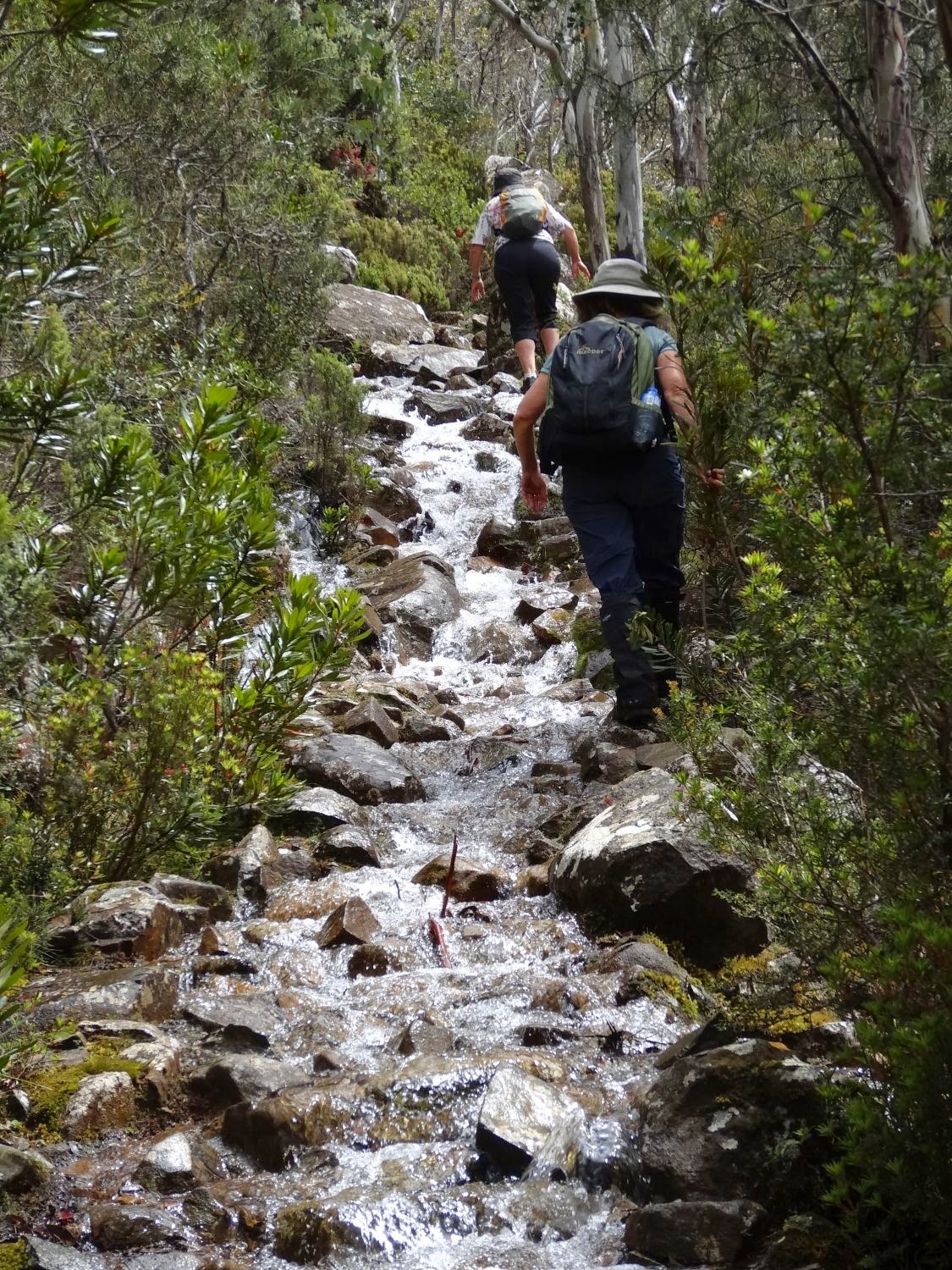
breast as red as a fiery sunset - flame robins. Upwards -and the track now became a creek,
yesterday’s rain tumbling down the rocks of the track. We picked our way
carefully through the torrent.
Further up, and a huge boulder the size of a garden shed had rolled down from the high slopes, across the track and down a bit. It was held from further descent by a thin wire. We sat here for morning tea, I was looking around for another bird.
 |
| photo Roger Whittaker |
Further up, and a huge boulder the size of a garden shed had rolled down from the high slopes, across the track and down a bit. It was held from further descent by a thin wire. We sat here for morning tea, I was looking around for another bird.
the invisible bird
tantalises with it song;
no feral cat meal
We were enjoying ourselves, the clean Roaring Forties air, the
views, so much so that we kept on going. So were a number of other walkers.
Then a trail runner, heaving for breath, passed us - Why? asked Julie. But just
beyond the fern gully had been a memorial for a young man who had died in 1901
on the ‘Race up Mt. Wellington’. Up we went, and it seemed we’d make the
pinnacle. I managed to recognise dog rose - Bauera
genus. And then, where rocks took over from
plants, the alpine level, a few hardy Brachycomes with their purple daisies.
But we couldn’t figure out where an amazing scent was coming from. It was an incense of honey, spice and rhubarb, I thought, thick and dreamy. But the diversity of plants simplified as we climbed closer to the peak, and it became obvious.
 |
| photo RW |
But we couldn’t figure out where an amazing scent was coming from. It was an incense of honey, spice and rhubarb, I thought, thick and dreamy. But the diversity of plants simplified as we climbed closer to the peak, and it became obvious.
tough shrubs
blossoming
at the rocky peak -
a frenzy of bees
That last stretch had been quite steep. Sweat and effort took us
out of the shelter of the slope.
like a razor
shaving Mt.
Wellington’s peak
cold wind
they hunch in the
wind
conquerors of the mountain -
droves of drivers
We didn’t last long at the top either. We turned around after a
quick look and headed back down the track for lunch. The beauty of the walk
back down was to have that glorious view, a maze of islands, landforms and sea
right before us. When we got into the shrub level again, we found a dismal
little spray of feathers, indicating a killing. A cat had had a meal of
rosella.
 Oh, the pain near the end - sore feet, sore kees, sore legs - I’ve just got to make it to the car.
And we did.
Oh, the pain near the end - sore feet, sore kees, sore legs - I’ve just got to make it to the car.
And we did.
That night I went to a literary event which was crackling with
culture. A huge crowd, about two hundred people, turned up to Fuller’s bookshop
in Hobart to launch “Transportation:
Islands and Cities”, a crowd-funded
collation of short stories edited by Rachel Edwards. I drank cherry, strawberry
and pear cider, and listened to selections by several of the writers. I
heartily recommend this book. Here is their website:
www.transportationbook.com
www.transportationbook.com
Mistakes. Once again I forgot to take my pocket knife out of my
handbag before I boarded the plane. Lucky for me, I had time to rush back to
the check-in counter and send it into the bowels of the plane in my handbag. It was a vile take-off and climb, because of the strong winds assaulting Hobart.
A guy on the plane
said to me, We can do much more than we
think we can.
“Yes.” Waratah is a place
where schoolchildren walked around in gumboots in winter because of the deep snow, in its heyday. Long-time resident Spence said to me, “It only snowed twice here this winter”. The day before the flight I had climbed up 800 metres and then
down again. I didn’t think I could do that. So maybe we can even slow the pace
of climate change.
(1) p.18 “Waratah
- pioneer of the west” Margery Godfrey 2nd. ed. 2007
 |
| thanks RW |