Thursday, October 22, 2015

Kanangra - the view from the top

Moi on the plateau


the sky speaking
through a muffler of clouds
something about rain


I’ve just come back from another ‘book’ trip  -


to Kanangra with Dave Noble. Our timing was good - just before the thunderstorms took hold of the Sydney region. 


a photo stop
the flies gather round Dave
for a possible bite


 Here are some of his (extraordinary) and my (ordinary) photographs.

the coal seam cave
 So many things to see! Caves! orchids! flowers! waterfalls! water pooling in rock hollows! native bees! stone! distant valleys and mountains! 


striated rock orchid - Dockrillia striolata


bothered
the falcon shifts his stance

soars away

Peregrine falcon

And to hear - many different birds! lyrebird, bowerbird, whipbird, white-throated treecreeper, currawong, honeyeaters....thunder....waterfalls.....rain.....fire...and flies, always the flies. 


Stypandra glauca


All the flutterbies were out. There was a beautiful green-striped one - green for "Go!". This one, on the pea flowers,  was less fluttery.

Sunday, October 11, 2015

Cox's river


who is more frightened
the brown snake
or me

Ten years ago I walked down Cox’s river with ecologist Clive Heywood Barker and I wrote about it for my book “Into the Blue”. Last week I did the walk again as a leader for  the Conservation Society Saturday walkers. It was a hot day and I planned to get to the junction with Little river. The walk touched on the nineteenth-century history of contact between the original Gundungurra inhabitants and the new settlers. We stopped at the O'Reillys’ shack at Cullenbenbong. What is left is the kitchen, which was built separately in case there was a fire. This was a common practise for settlers.


Bernard O’Reilly’s reminiscence of his childhood in “Cullenbenbong”  included memories of the Lynches, indigenous people who had to surf the massive changes brought about by white settlement. Next we drove to the traditional campground on the Cox's river, where their family (Lynches) bought a selection in the 1880’s. Our walk started here. 

After crossing the river, we walked downstream. We came across quite a few other walkers, and a father and son fishing. The Dad was frustrated by the number of European carp swarming the river (Warwick had seen them at the crossing). No trout, he said. 

By contrast there were quite a few snakes. They've come out of torpor and are a bit sluggish, so we were on the lookout for non-sticks that might resent being trodden on. 


We didn't quite make it to Little river junction. It was a hot day, so ambling along, first in the shade of Casuarina cunninghamiana (river oak) trees, and then along the granite banks, was perfectly fine. On the way back Harold and I took a swim in a large pool - deliciously cool, and in places there was sand underfoot for a massage. 

Thanks to Bob and Harold for some of the photos. 


Monday, August 10, 2015

Sprinter


Acacia brownei


It is sprinter! That is, a season half-way between winter and spring. Most of the wattle is flowering magnificently, and especially at the margins of roads and tracks. The heart lifts away from …all of that difficult stuff, in the yellow of it all.  Here’s a haiku from my book, which I hope makes sense, out of context. It quotes the Paul Kelly song about Vincent Lingiari, who led the walk-off at Wave Hill station in 1966, to protest working conditions for aboriginal people.


Acacia terminalis

“From little things
big things grow”
bright wattle flowers


Acacia ulicifolia, Prickly Moses, is already browning. But the Hardenbergia violacea, Happy wanderer, is the opposite of wattle. It is close to the ground, rambling over everything, and if you didn’t stop and look, you might not fully appreciate its beauty. Is that like the little niggling voice in the heart that urges you to do the right thing?

holding spring
in violet fists,
Hardenbergia

Happy wanderer


I was so glad I listened to it yesterday. And that I wandered happily on Saturday, and saw the vine rambling at the old Cox’s road, near Hartley.

Convict stonework on Cox's road

Saturday, July 18, 2015

Winter magic


It snowed yesterday in the mountains. It was super cold, and the highway was closed, so I decided to go by train to see my dentist. It was packed - families, tourists, lots of little kids. The highway had been closed at Lawson but by the time the train rolled through in the early afternoon, there was no more snow. The next station is Bullaburra and then Wentworth Falls, and then...


"Aaaah!"
everyone on the train
the first sight of snow


I got off the train at Leura, where the railway cutting had saved the snow from melting. People were milling about, cameras running hot.


clouds stacked
like massive fridges
in the western sky


After seeing my dentist I walked to Katoomba, down through the industrial area where the snow, slush and ice lingered.


This paddock was covered in snow years ago when I first came to see the Blue Mountains in my old bomb VW. This is where my car stopped and would not start again. It's taken me a long time to remember where this took place, because quite a number of businesses now dot the landscape. Back then, I was alone in a valley of scintillating white coldness. I don't know how I rescued myself from this scenario - somehow.


It’s a steep hike up to town, I heated up in all my layers of clothing.


an Indian
photographs the snow -
throws a snowball


I went to the Co-op, and it was the most fun I’ve ever had buying groceries – truly winter magic!


Wednesday, May 27, 2015

The Shack - a sketch for "Into the Blue: walks in Gundungurra country"


Kowmung river


In the middle of winter 2011 Tara and I visited The Shack, a property on Scotts Main Range in the southern Blue Mountains, owned by the Catholic Bushwalkers. Maureen and Bob Anderson were my hosts. This is a rough sketch of that trip for my forthcoming book.

The property has an interesting history. In 1875 aboriginal man John Jingery bought it on conditional purchase - this term is the same as ‘selection’, the conditions of purchase being that he had to show that he was living on it and had made 'improvements'. There was a time limit of three years to show fences, house, clearing. 

It was a bit wild when Maureen and Bob took us for a walk. All of this country  is bisected by what used to be the Cox's river, but is now Lake Burragorang ( Sydney's main dam and water supply). 

the lake full
like a satisfied diner - 
black ruffle of wind

On the ridge where you can see the lake in the distance, ( covering what used to be the Burragorang valley) there are axe-grinding grooves in the loose stones.


Lake Burragorang -photo DW Noble


traces on the road
of an ancient river - 
round smooth stones

At a junction there are a very few remains of what used to be Robert O'Reilly's selection. Much later on, he leased his land out to Bert Reiner.  

Bert's ancient fence
wire slackened and curling out
cannot hold the wind


We walked on. John Jingery lost hold of his stony ridgetop in 1877. 

Maureen and Bob took us to Kowmung lookout, where the river, undammed and untamed, is far below. 


And then they took us to a cave where people may have sheltered in times long past. 


It was quite a long walk out to the Mt. Cookem lookout. On the way, we saw glossy black cockatoos  - as they took flight, they looked like stained glass windows with their red streaks of feather. At the end of the road, you can look out to the northeast, and see Black Dog ridge. 

It was the best route out of the Burragorang valley to the Megalong valley.

from Cookem - Black Dog ridge 2nd from left or 3rd from right

We had walked quite a long way, and turned back towards home and warmth and shelter. My daughter strode out in front. Winter - it is lyrebird breeding season, when the male sings his heart out. 

if I could
I would be your lover
lyrebird on the left


Thursday, May 7, 2015

Autumn in New Zealand


northern rata flower - a relative of pohtakawa


I went across ‘the ditch’  for a visit to my homeland - just came back last week. Here is a rough sketch, in haiku, of my time with family and friends. From Auckland, where I’m from, we went up north to a place on the coast below the Bay of Islands.

the sound of waves
slapping the land
lipping the sand


my brother snoring
in the room next door
tuned to the sea

One of the best things about this part of the world is the pohutakawa trees. 


They love the coast, have masses of red flowers in summer, and are great to climb in. We had a large old tree in our garden when I was a child. My sister tells me that I used to climb into it with my dolls and read to them from the Bible.


I went down to Kawhia, south of Auckland. It being autumn, we thought we might go mushroom-picking in the paddocks behind the sandhills.

no mushrooms today
the sheep watch curiously
in the fading light

Mt. Pirongia beyond Kawhia harbour
While New South Wales was being slugged by torrential rains and hailstones, the weather in this west coast village was fine most of the time (unusually so). We decided to go for a walk on Mt. Pirongia, which rises a little inland of the harbour at Kawhia and is a volcanic mountain, like Mt. Taranaki down near New Plymouth ( called Mt. Egmont when I was young). You can see Pirongia from a long way off.  Our friend L. remembered seeing it from the army base at Ngaruawahia where he lived as a child.


There were some really wild blue fungi growing beside the track - and others less gaudy - white ones. The blue ones are hallucinogenic - don't try this at home, kids!
the epiphytic northern rata - vines climb the host

But the tawa forest we walked through, on a very good track, was rather quiet. We heard bellbirds - the odd tui - and a whirr of wings.

kereru sits through
the peak of our interest -
what a snowy breast!

Possums, stoats, rats and humans have had a huge impact on the native birdlife of New Zealand.  There is a major conservation effort in removing or excluding these pests. We think possums are cute - not so in New Zealand. They are also responsible for the ‘silent forest’ as it is called. The Acclimatisation Societies in the nineteenth century, which thought it would be cute to have bunny rabbits and other foreigners hopping about in Australasia, did a lot of damage to biodiversity. This forest has been peppered with bait traps, and we were thrilled to see the northern rata flowering. Normally the flowers are just what the possum had in mind for its meal. We were there just at the right time to see it - autumn.

As we climbed the last bit to Wharauroa lookout, another pest manifested.


goats hurtle down
the rocky hillside
goat smell follows

The rock hillside they descended was almost vertical - no problemo! They were so fast.

At Wharauroa lookout, Raglan in the northwest behind us
For the first time ever, I attended the Anzac ceremony at Kawhia to pay tribute to the sacrifices made by many, in times of war. I marched for my grandfather, Percy Levy, who went to World War One. It was very moving, without making any statement about the rightness or wrongness of war, any war. In this tiny town, there was a huge turnout, people had gathered from all around. 


A pipe band from Te Awamutu played and gave dignity and emotion to proceedings.   

something so lovely
from something so ugly -
wreaths on Anzac Day


We marched to a cenotaph outside the library, where I was standing next to a man, and a friend came up to greet him. They rubbed noses: so intimate, to hear their breaths mingling like that. What is this form of greeting called? I don’t know. But I always come away from New Zealand / Aotearoa having learned a new Maori word or concept. This time, I learned “tangata whenua” which means, “people of the land”.


Monday, February 23, 2015

Bees, bees! garden haiku from 2014


scarlet runner bean


I once had this idea that I would, instead of writing haiku, create a form called ’kikuyu’. Instead of a compact expression of a moment in time, the kikuyu would, like the weed, ramble on and on, climbing away from its subject to poke a runner under a carpet  then poke itself out on the other side, where there is a nice little herb garden full of nutrients which are just right for the plant from Kenya to shout its happiness at being transplanted to a country in the Southern hemisphere where the native running plants tend to be small, tough, adapted to extremities, conservative therefore in their adaptive strategies….. you get the idea of the ‘’kikuyu’.


Beans, tomatoes, gourd, zucchini, cucumber all rely on the pollination of their flowers by bees

Last year I made my pesto ( basil, garlic, oil, parmesan cheese and pine nuts) in autumn.

she hitched a lift inside
feeble bee
on the basil bush

I suppose a kikuyu of this poem would run something like:

she hitched a lift inside
feeble bee
who could not buzz off from the basil bush with its delectable white and mauve flowers, could not lift a wing, surely this isn’t the end of service to the queen?


Awful. Truly awful. I don't think the kikuyu has a very bright future.

This year we've made some pesto already, and it has been given away, taken away and eaten. I often brush against the basil bush and wonder sometimes if I’ll get stung. But I regard the bees with great affection. The workers! ("united, will never be defeated…”) They’re defeated by heat however. Last November, on the 43.5*C day,  most of the bees died. Only one or two survived and came back to work the basil bush. On such hot days, they die of thirst unless there is a source of water near their hive. To digress away from last year's garden haiku,  I wrote this, a long while ago:


my tears have dried - 
bees take tiny drinks
from the sand


It was a hot day, near a creek, and there was moisture enough for a bee, in between the grains of sand. There’s often a bee or three drowned in swimming pools, floating around. I was so glad to see their numbers gradually increasing over summer. 

Birds play an important part in a productive garden, mainly in feeding on pests. 

a quick little bird
with yellow eye make-up
becalms my labours

All too soon last year, winter was gone. The head of the Royal Botanic Gardens in Melbourne, Tim Entwisle maintains that in Australia there is a season after that called ‘sprinter’. This is the beginning of the growth period.

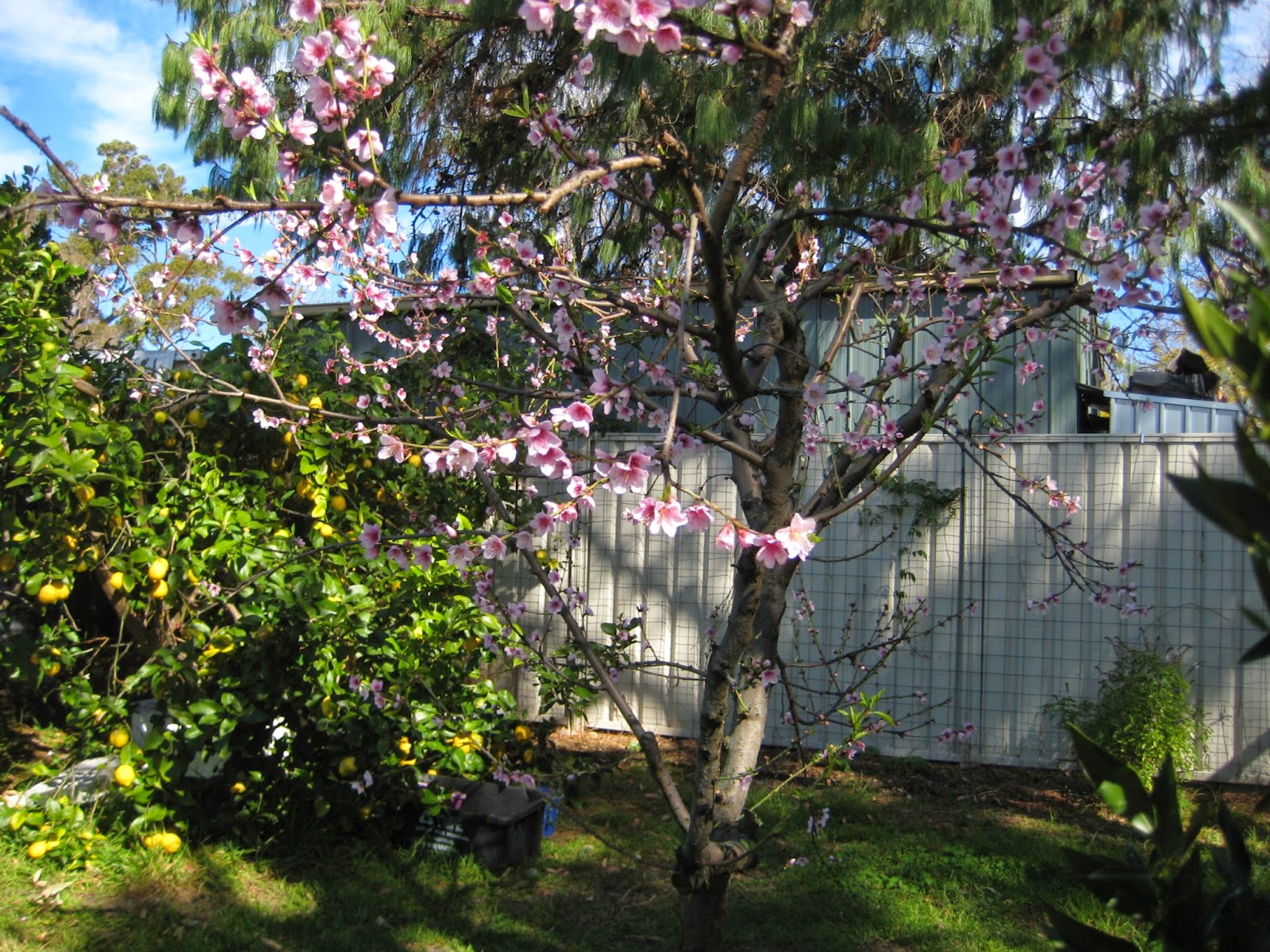
two bees
crowd into one peach blossom –
one bee too many


The next season, he says, is spring and that is followed by ‘sprummer’. I'm not sure which season the borage started to flower. It’s  a useful plant for its roots, and the blue flowers, which you can add to a salad. Last December I sat rohatsu (a meditation retreat) with my zen mates at Sydney Zen Centre, and we walked down to the community garden in Annandale, silently, together.

the zebra-striped bee
buzzes the borage flowers
her motor revving

I made a change to this haiku – originally it read:

the white-arsed bee
buzzes the borage….

I just don’t like that ”a” word. Call me old-fashioned. So I took it out.


another kind of flower